
JKE-Solutions
Control Architecture
The Operational Principle
Detect – Alert – Suppress
Monitored. Controlled. Verified.
All JKE platforms follow the same structured control principle:
- Detection input monitoring
Continuous supervision of detector circuits and activation logic. - Alarm and warning control
Clear pre-release signalling and system status indication. - Controlled activation sequence
Structured aerosol release with defined delay logic and ventilation handling. - Continuous supervision
Power supply, output circuits and activation loops are actively monitored at all times.
This architecture ensures that system readiness is verified before activation is required.

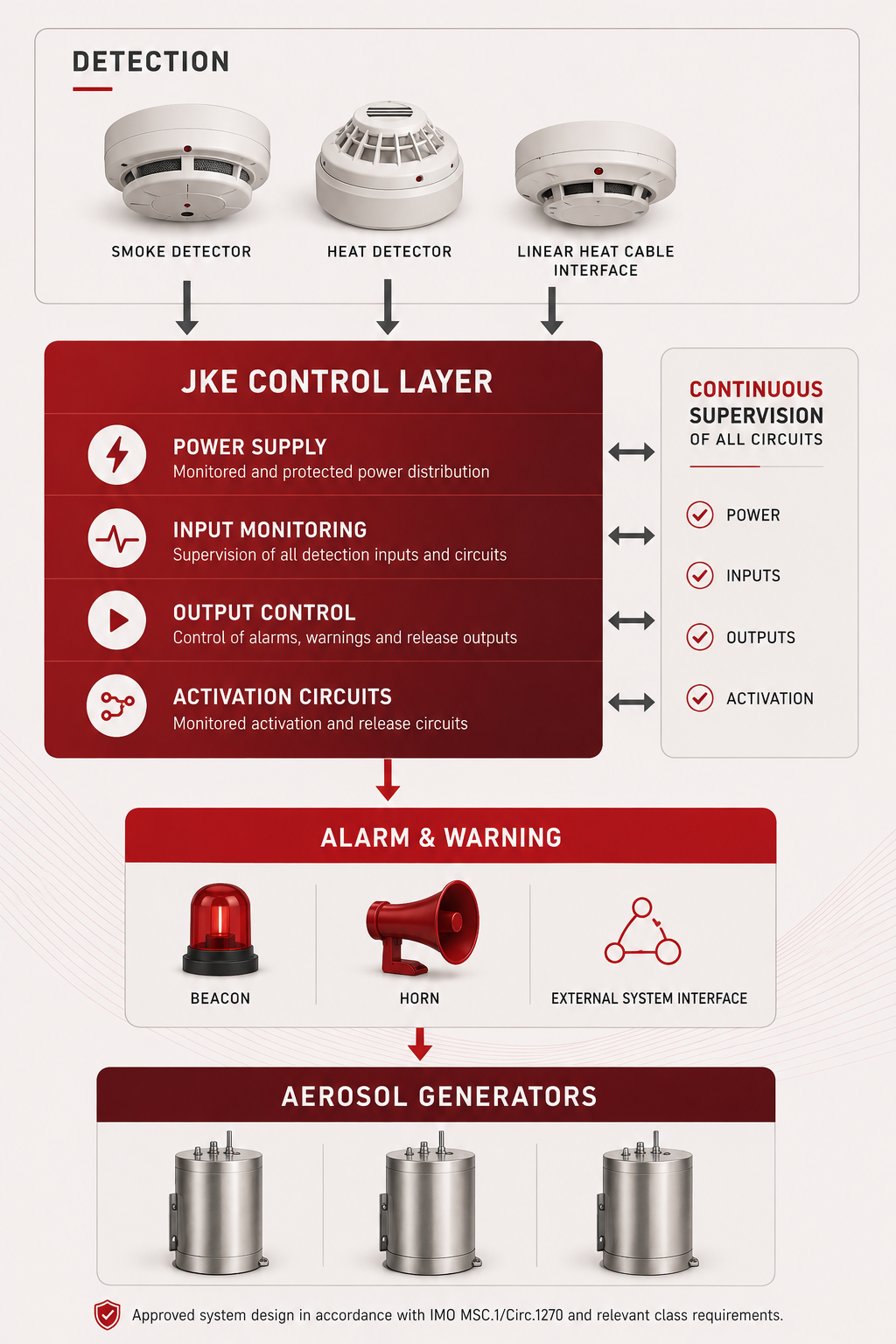
Continuous Supervision – The Core Layer
The control and monitoring layer
At the center of every installation is the control layer.
This layer supervises:
- Power supply integrity
- Detector loop continuity
- Alarm and warning outputs
- Aerosol activation circuits
- External control functions
- Any deviation — disconnection, voltage irregularity or circuit fault — is immediately indicated and logged.
This provides operational transparency for:
- Installers
- Vessel owners
- Surveyors
- Classification authorities
Fail-Safe Design Philosophy
Designed for predictable behaviour
The architecture follows a fail-safe principle:
- Fault relay outputs default to fault state if power is lost
- Critical circuits are continuously monitored
- Activation logic requires defined conditions
- Isolation functionality ensures safe maintenance
This approach minimizes the risk of unintended activation and supports safe operational handling.
Platform Implementation
One philosophy – two platform implementations
While the core architecture remains consistent, it is implemented differently depending on installation category
FS12 – Certified installations
For IMO-based marine installations requiring:
- Modular loop-based architecture
- Structured system segmentation
- Documented supervision and event logging
- FS12 provides a scalable architecture suitable for regulated environments
- FS10 provides structured control and supervision for aerosol fire suppression systems in non-IMO marine applications.
DNV approval
FS10 – Non-IMO installations
For smaller marine installations aligned with ISO 9094:
- Compact control architecture
- Configurable activation logic
- Continuous supervision of critical circuits
- Efficient commissioning
- FS10 delivers structured control in a streamlined platform.
Why Control Architecture Matters
Beyond components
Detectors and aerosol generators are critical components — but without structured control and supervision, system integrity cannot be verified.
Control architecture ensures:
- Verified readiness
- Controlled release
- Transparent fault handling
- Regulatory alignment
- Documented system behaviour
- In marine environments, reliability must be demonstrable.
Quality equals safety.
